
"countries and regions"
10000 article(s) found

A brief introduction to the origin, development, history and culture of Santo Domingo boutique coffee beans
To trace the origin of Tibica, we should first talk about the coffee trees originally planted in Martinique. These trees were planted by Dominicans as far back as the early 18th century, so Dominica began growing coffee as early as that time. For a time, the Caribbean was almost synonymous with coffee production, but in recent years Cuba, Haiti and other producing areas have been severely damaged by Hurricane George.

Description of flavor, taste and aroma characteristics of pure and soft Santo Domingo boutique coffee beans
Such flavor characteristics are not only related to varieties and the quality of planting soil, but also closely related to the picking and handling of raw beans. Coffee in Dominica is selected by the manual method with the highest cost, and workers mainly consider the fullness of coffee granules, and the other is to see whether they are even. according to these conditions, the coffee beans with the fullest and most uniform particles are graded.

A brief introduction to the description of the regional flavor produced by the grinding scale treatment of Columbia Huilan coffee beans
Colombian coffee is divided into more than 200 grades, which means that the coffee is very regional. The country's coffee-producing areas are located in the Andes, where the climate is mild and the air is humid. Colombia has three Codiera mountains running north and south, right into the Andes. Coffee is grown along the highlands of these mountains. The mountain steps provide a diverse climate, and it is the harvest season all year round.

A brief introduction to the cultivation of pure and gentle Santo Domingo boutique coffee beans, geographical location, climate and altitude
To trace the origin of Tibica, we should first talk about the coffee trees originally planted in Martinique. These trees were planted by Dominicans as far back as the early 18th century, so Dominica began growing coffee as early as that time. For a time, the Caribbean was almost synonymous with coffee production, but in recent years Cuba, Haiti and other producing areas have been severely damaged by Hurricane George.
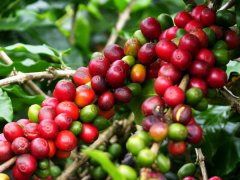
Which countries and regions can grow coffee? What conditions do you need to grow coffee?
Since coffee trees are tropical plants, they need to be planted in warm places. The main planting area is distributed between latitude 25 south and latitude 25 north with the equator as the center, so this area is also called the coffee belt. However, even in the coffee belt, Arabica and Robeska do not grow in exactly the same area, but grow up in an environment that is more suitable for their own growth.

Read the name of coffee beans
Why do coffee beans have such long names? Why is coffee divided into single, deep roast and Italian? Where did all these names come from?

El Salvador Himalayan Coffee Flavor Description Region Features Roast Degree Boutique Coffee Introduction
El Salvador is tied with Mexico and Guatemala as the producer of Asa and Meldo, and is competing with other countries for the top one or two places in Central America. Highland origin, for the size of large coffee beans, fragrant taste mild. As in Guatemala and Costa Rica, coffee in El Salvador is graded according to altitude, with the higher the altitude, the better the coffee.

Tarasu, the capital coffee region of southern Costa Rica
Located in the south of the country's capital, San Jose, Tarasu is one of the most valued coffee growers in the country. La Minita Tarrazu coffee is a famous local product, but its production is limited, about 72600 kilograms a year. It is grown on a piece of land called La Minita, which is owned by the McAlpine family of England.

Description of flavor of coffee beans in Honduras; introduction to the method of regional treatment of varieties of taste manor
Honduran Coffee Bean Flavor description Grinding scale Variety Taste Manor Regional treatment method the extremely balanced characteristics of Honduran coffee make it widely used. Can be used to mix coffee, can also be used as a single product to brew, mixed with Honduran coffee Italian concentrate will have a surprising effect. Although in troubled times, coffee can also grow its own wonderful, it is not difficult

Costa Rican coffee beans taste taste estate region introduction Costa Rican coffee flavor
Coffee is an important source of income for Costa Rica, introduced in 1808 and cultivated for 200 years. Costa Rica has a third of the population invested in new villa sarchi, new villa sarchi, coffee-related industries, Costa Ricans say coffee has changed the country, can enjoy a rich environment, coffee does contribute significantly; although Costa Rica's country

A brief introduction to the origin, development, history and culture of pure and gentle Santo Domingo boutique coffee beans
Such flavor characteristics are not only related to varieties and the quality of planting soil, but also closely related to the picking and handling of raw beans. Coffee in Dominica is selected by the manual method with the highest cost, and workers mainly consider the fullness of coffee granules, and the other is to see whether they are even. according to these conditions, the coffee beans with the fullest and most uniform particles are graded.

A brief introduction to the cultivation of fine coffee beans in Santo Domingo with excellent acidity, geographical location, climate and altitude
In the early 18th century, coffee was introduced to Domiga from Martinique, and fine coffee was produced in the north represented by Hibao and in the south, including Okayabani Santo Domingo. Among them, the coffee produced by Santo Domingo and Barney, which is almost synonymous with domiga coffee, is a world-famous high-quality coffee. Santo Domingo coffee, which is characterized by freshness and elegance,

A brief introduction to the treatment method of grinding degree and baking degree of Santo Domingo fine coffee beans with excellent acidity
In the early 18th century, coffee was introduced to Domiga from Martinique, and fine coffee was produced in the north represented by Hibao and in the south, including Okayabani Santo Domingo. Among them, the coffee produced by Santo Domingo and Barney, which is almost synonymous with domiga coffee, is a world-famous high-quality coffee. Santo Domingo coffee, which is characterized by freshness and elegance,

Rwanda Coffee Flavor Description Region Characteristics Roast Degree Boutique Coffee Bean Introduction
New administrative divisions were introduced on 1 January 2006. Rwanda is divided into four provinces (Rwandan: intara): Province de l'Est, Province du Nord, Province de l'Ouest, Province du Sud, Ville de Kigali and one municipality (Kigali), comprising 40 provinces.

Introduction to the taste manor of Colombian Huilan Coffee produced by regional treatment
Columbia Coffee is a representative and excellent variety of Arabica coffee. It is a traditional deep-roasted coffee with a strong and memorable flavor. Colombia, located in the northwest of South America, is a beautiful country with a long history. Indians have lived on this land since ancient times. 1531 AD

Introduction to the regional treatment method for the production of varieties of hand-washing temperature of Huilan coffee in Colombia
Colombia Huilan Coffee Water washing temperature Regional treatment method Colombia is rich in products, especially coffee, flowers, gold and emeralds are known as the four treasures. In 1808, a priest introduced coffee to Colombia for the first time from the French Antilles via Venezuela. Today, the country is the second largest coffee producer after Brazil and the largest Arabica coffee in the world

El Salvador Coffee, the smallest coffee producer in Central America, introduces Siberi in the Santa Ana volcano region.
It is located in Central America, bordering Guatemala and Honduras in the north, and the Pacific coastline in the west and south. The smallest country in Central America and the most densely populated country in Central America. The land area is 21393 square kilometers, the population is 6.25 million (data 2012), and the population density is 327 people / square kilometers. The economy is dominated by agriculture. In 2011, per capita domestic production

Nicaragua Coffee Estate Delight Estate Matagalpa Region
Because of the ethnic nature of the Latin American people, it is difficult for foreign buyers to do business directly with the Latin American people. The Latin American people do not attach importance to credit, do things too casually, the quality of shipments is not accurate, and the exported products are also adulterated with impurities. However, Latin America actually has a good planting environment suitable for planting agricultural products that envies the world. Therefore, we came to Nicaragua.

Introduction to the taste treatment method of region flavor description of Ethiopian coffee manor brand
Ethiopian coffee farm brand flavor description taste treatment method introduces that Ethiopian coffee beans grow in a close to natural environment, after years of planting under the same growth conditions, Ethiopian coffee beans have gradually adapted to the environment here. More than 60% of coffee beans are grown in forests or semi-forests. A village house that grows coffee in a large area.

Flavor description of Rwandan fine coffee beans Grind scale Manor Introduction to regional processing
Rwanda is a small African country, and the local people are also relatively poor, but it produces very good straight coffee, which is different from its neighbors Kenya and Ethiopia. Rwanda's coffee is mainly round bourbon, and the taste is not as prominent as Ethiopia and Kenya, but the uniformity is excellent. Rwanda Karnogi coffee is grown and harvested by local smallholders